Cosmetic Dentistry
E-Max Crowns
Explore e-max crowns at Apollon Clinic. Understand individual planning, treatment stages, suitability and the questions to discuss with your dentist.
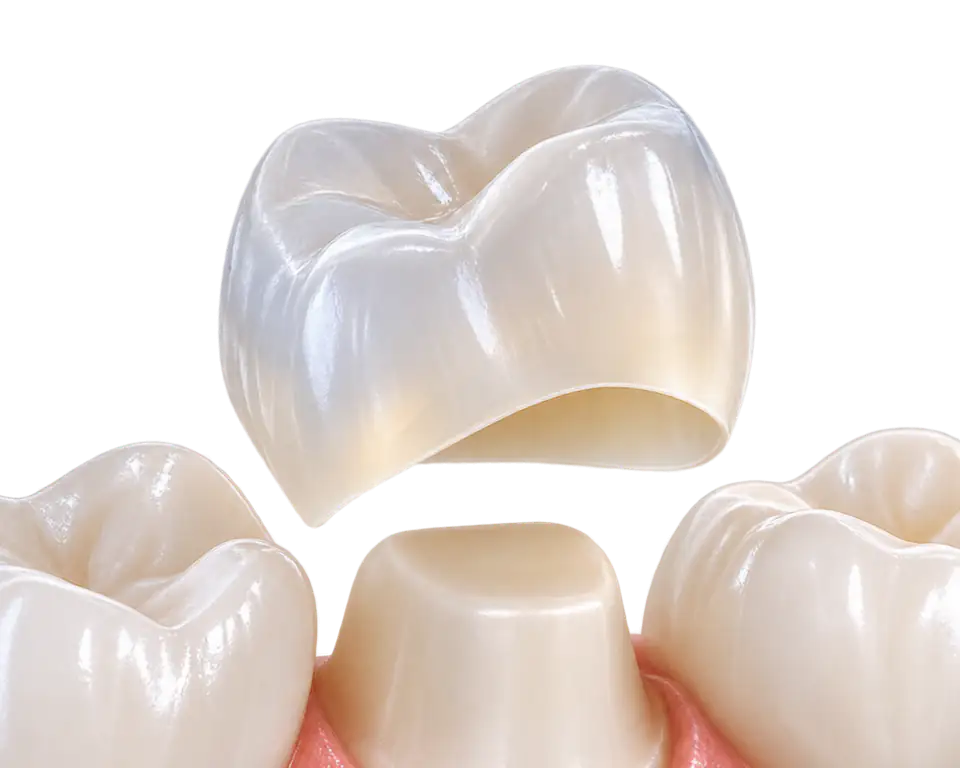
E-Max crowns commonly refer to lithium disilicate glass-ceramic restorations. They may be considered where the tooth condition, bite and aesthetic requirements make this material appropriate.
01 · Cross-section
E-Max Crowns
02 · Filling
Decay is removed, the tooth is filled in its own shade.
For small and medium areas of decay, the affected tissue is removed and the cavity is closed in layers with tooth-coloured composite.
- Tooth-coloured filling
- Inlay / onlay
03 · Root canal
Root canals are cleaned and filled.
When infection reaches the nerve, the canals are cleaned, shaped and sealed. The aim is to keep the tooth in your mouth.
04 · Crown
A crown completes the tooth.
If a lot of tooth structure has been lost, the tooth is protected with a custom-made crown. A bridge may be planned where teeth are missing. Which option suits you is decided at your examination.
- Zirconia crown
- All-ceramic crown
- Bridge
Planned around your needs
Your dentist evaluates remaining tooth structure and the forces on the restoration. Shade and translucency are selected in relation to neighbouring teeth and the appearance you prefer.
What treatment may involve
Planning includes preparing the tooth, recording its shape and checking the restoration before fitting. The process should allow you to discuss the proposed appearance.
What to understand before deciding
This material is not appropriate for every clinical situation. Crown preparation is irreversible, and complications can include sensitivity, fracture, loss of retention or later tooth problems.
Is E-Max always better than zirconia?
No. These materials have different properties. The choice should reflect the specific restoration and clinical requirements, rather than a universal ranking.
Before / After
Before and after, side by side.
- E-Max CrownsBeforeAfter
Yer tutucu: bu tedavinin vaka görseli eklenecek
E-Max Crowns
Illustrative example
- Treatment date
- 10 February 2026
- Before photo taken
- 3 February 2026
- After photo taken
- 17 February 2026
Patient treated at our clinic. Both photos were taken under identical lighting and shooting conditions, unretouched. Medically indicated treatment.
How long does it take to fit crowns?
A visit of five to seven days is usually enough: examination and impressions at the start, a try-in in the middle and cementation at the end. You wear temporary crowns in between. The exact schedule depends on your plan and is agreed with you beforehand. At the try-in we discuss shape and colour together.
How long do veneers take?
Five to seven days. Planning and a preview come at the start, a try-in in the middle and cementation at the end. Whether veneers suit you depends on the condition of your teeth and is decided at the examination, where your dentist also tells you if another solution, such as crowns, would fit better.
Won't zirconium crowns look artificially white?
Only if that is what you choose. You select the shade together with the dental technician from a colour guide, from natural tones to lighter ones. Before anything is permanently cemented, we show you the try-in, so that you can look at the colour and shape and talk it through with us in peace.
Do healthy teeth have to be ground down for a crown?
For a crown the tooth has to be reduced; this cannot be avoided. If your teeth are healthy and the concern is mainly appearance, veneers are the more conservative option. Your dentist tells you in your plan which option suits your situation. Both options are laid out openly, and the decision is yours.
How much tooth is removed for veneers?
With a classic veneer, a thin layer of enamel is removed. The examination shows whether a particularly thin veneer is possible for you or whether crowns suit your situation better, and your plan shows both options. If you grind your teeth, a night guard is needed to protect them, and we discuss this beforehand.
Treatment plan
Start with your own assessment
Tell us about your concerns and expectations. Your consultation is the place to compare suitable options, understand the estimated costs and decide whether to proceed.
Get Your Plan- Your details.
- What would you like to improve?
- Dental condition.
- Upload Photos / X-rays.
- Preferred contact method.