Implant Treatments
Dental Implants
Explore dental implants at Apollon Clinic. Understand individual planning, treatment stages, suitability and the questions to discuss with your dentist.
We use B6Pro® implants, a German brand.
Long-term confidence starts with the right foundation.
Replacing missing teeth begins with assessing the foundations for care. Explore individual implants, full-arch options and procedures that may be needed to support placement. The choice is guided by your anatomy, health and restoration needs.
Options include individual implants, full-arch approaches such as All-on-4 and All-on-6, and full-mouth planning. Bone grafting or a sinus lift may be considered where additional support is needed.
A dental implant is placed in the jaw to support a replacement tooth or restoration. It may be considered for one missing tooth or as part of a wider replacement plan.
01 · Implant
Dental Implants
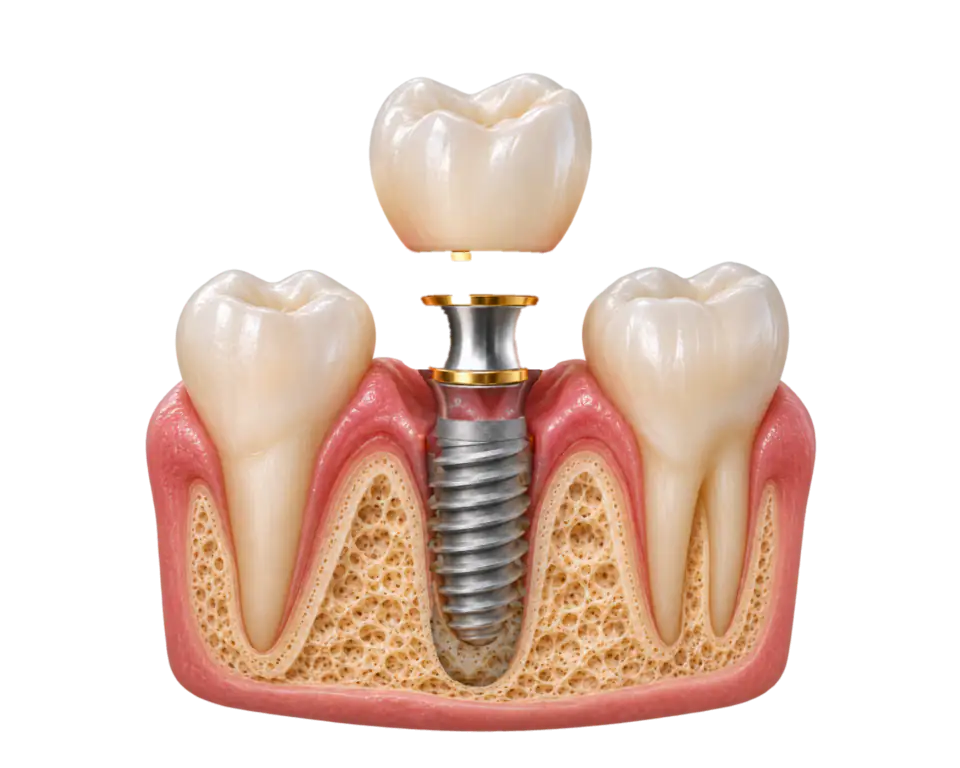
02 · Parts
Three parts. One tooth.
Each implant is planned as three separate parts: the body that sits in the bone, the abutment that connects it, and the visible crown.
03 · Surface
A surface that bonds with the bone.
The roughened titanium surface makes it easier for bone cells to attach.
- 3D
- ≈ 3 months
04 · Treatment
A new tooth, in two stages.
The implant is placed first. Once it has healed, the crown is fitted.
Planned around your needs
Your dentist assesses the missing teeth, available bone, gum health, bite and medical history. Imaging is selected where clinically needed. Alternatives may include a bridge, a removable denture or retaining a tooth that can still be treated.
What treatment may involve
Treatment may involve preparation, implant placement, healing and fitting the restoration. These stages do not always happen during the same visit.
What to understand before deciding
Implants can fail and may require additional treatment. Surgical risks include infection and damage to nearby structures. Daily cleaning and professional maintenance remain essential.
Can an implant be fitted immediately?
Sometimes, but immediate placement or a temporary tooth depends on specific clinical conditions. It cannot be promised from photographs alone.
Before / After
Before and after, side by side.
- Dental ImplantsBeforeAfter
Yer tutucu: bu tedavinin vaka görseli eklenecek
Dental Implants
Illustrative example
- Treatment date
- 10 February 2026
- Before photo taken
- 3 February 2026
- After photo taken
- 17 February 2026
Patient treated at our clinic. Both photos were taken under identical lighting and shooting conditions, unretouched. Medically indicated treatment.
How many visits does implant treatment need?
Usually two visits. We recommend 7 full treatment days for the first visit and 10 full treatment days for the second, after the healing period. Depending on your individual treatment plan, a further visit may be needed. Your plan shows you clearly what applies in your case, so that you can plan ahead.
What if I do not have enough bone?
In many cases an implant is still possible, with a bone graft or a sinus lift. Whether either is needed only shows on a 3D X-ray. For that reason a possible bone graft is named in your first plan, and whether it is needed, and how much is done, is confirmed after the examination at the clinic.
Does implant placement hurt?
The procedure is carried out under local anaesthesia. Swelling and a feeling of pressure for a few days afterwards are normal. Your dentist explains what to expect before treatment starts, so that nothing comes as a surprise. If something worries you after the appointment, you can call the clinic or write to us.
Are four implants enough for a whole jaw?
If there is enough bone, yes: the two rear implants are placed at an angle and support the bridge over a wide base. If the bone is too narrow for this, we suggest All-on-6 instead. Which of the two fits you is decided by your 3D X-ray and the examination, and the decision is written into your plan.
I have worn dentures for years. Am I suitable?
Often yes, even if some bone has been lost. If you have a recent X-ray, send it to us with your request. Our dentists can then give you a preliminary assessment from your documents. The final decision is made after the examination and the 3D imaging at the clinic.
Treatment plan
Start with your own assessment
Tell us about your concerns and expectations. Your consultation is the place to compare suitable options, understand the estimated costs and decide whether to proceed.
Get Your Plan- Your details.
- What would you like to improve?
- Dental condition.
- Upload Photos / X-rays.
- Preferred contact method.